

The SEC is expected to announce changes to its foreign private issuer (FPI) regime later this month, potentially forcing Chinese companies listed in the US to play by the same rules as their domestic peers.
But while policymakers have spent the past year debating whether to end this special treatment, some PRC companies trading on Wall Street have been very busy making sure insiders have extraordinary voting powers.
Of at least 253 Chinese companies that trade exclusively in the US, more than one in four has introduced or increased super-voting rights since going public, giving founders and insiders a tight grip on corporate control.
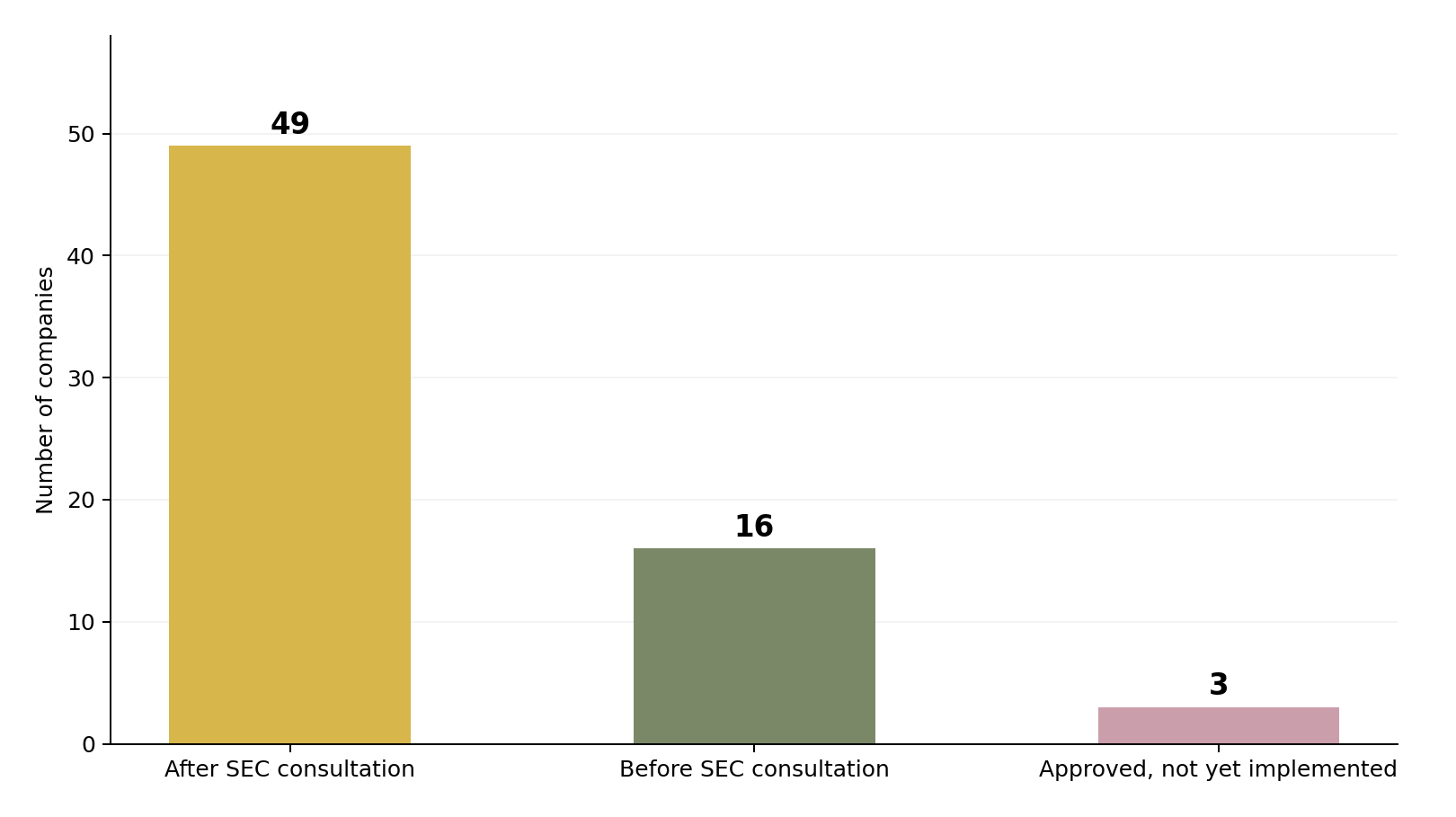
The timing of these moves makes the story much more interesting. The SEC announced its consultation on FPI eligibility on 4 June 2025. Since then, 49 companies have introduced dual class shares or increased their voting rights. That accounts for more than 75% of all the post-IPO changes identified.
In some cases, this has left insiders holding only a fraction of the equity with an overwhelming majority of the votes. That leaves outside investors with little meaningful influence over who sits on the board, how the company is run or what happens if management decides to restructure, go private or abandon its US listing.
The irony is that these companies can take advantage of exemptions from Nasdaq’s voting rights rules that are not generally available to their American peers. While US companies face restrictions on increasing insiders’ voting power after listing, FPIs have considerably more room for manoeuvre.
This analysis began with a list of Chinese companies trading on US exchanges compiled for the US Congress. This gave a snapshot of PRC firms as of March 2025. Those with secondary or dual listings elsewhere were then excluded, as were companies that have since delisted. This left a total of 253 firms.
Our review found that 65, or 25.7% of the total, had introduced dual class shares or increased existing super-voting powers since their IPOs. Of these, 49 (19.4% of the total) made the changes after the SEC announced its consultation on foreign private issuer eligibility in June 2025.
Three additional companies had proposed or approved changes to voting rights that had not yet been implemented and were excluded from the tally. The analysis is based on company disclosures and SEC filings up until October 2026.
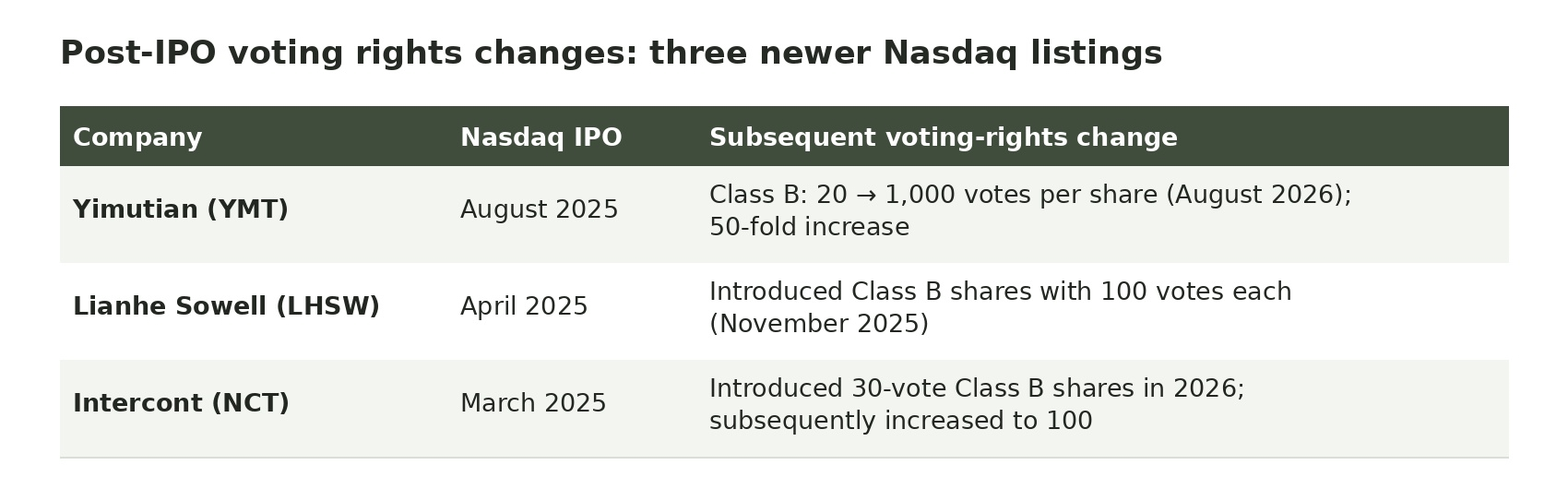
The sample does not include companies that listed in the US after the congressional list was compiled. But a quick look at newer entrants has already identified a few that have introduced or increased dual class shares since listing, suggesting the trend has continued:
FPI status enables overseas companies listed in the US to enjoy a lighter rulebook than their American counterparts. They are exempt from certain reporting and corporate governance requirements, including quarterly financial reporting, US proxy rules and some shareholder approval requirements. Instead, they can follow the rules of their home jurisdiction in a number of areas, even when their shares trade exclusively in the US.
And it turns out that one particularly popular exemption is in relation to voting rights.
Nasdaq rules generally prohibit US listed companies from doing anything that disproportionately reduces the voting rights of existing shareholders. But FPIs can elect to follow home-country practices instead. For Chinese businesses incorporated in the Cayman Islands or British Virgin Islands, this gives them considerable freedom to introduce super-voting shares or increase their voting power after listing, something US domestic issuers would struggle to do.
Some PRC companies have taken this to extraordinary lengths. Shanghai-based healthcare education and services firm Zhongchao Inc [ZCMD] listed on NASDAQ in February 2020 with a dual class structure that gave its B shares 100 votes.
In February 2026, the voting power of these shares was increased to 1,000 votes each. Jin Medical [ZJYL], a Chinese manufacturer of wheelchairs and other mobility equipment, took a similar route. In July 2026, it increased the voting power of its Class B shares from 30 to 800 votes each, almost 27 times their previous voting power. Its IPO was in March 2023.
Similarly, Huzhou-based digital advertising and tech services firm LZ Technology [LZMH] had only been listed on Nasdaq for 15 months when it decided that 10 votes per share were not enough. In May 2026 it increased the voting power of these shares to 300 each, a thirty-fold increase.
Kaixin Holdings [KXIN], formerly Kaixin Auto, went from 20 votes per Class B at IPO, increased them to 250 by 2024 and then hiked them further to 1,000 in September 2026, following a series of share consolidations and capital restructurings. So the voting multiplier increased 50-fold between 2023 and 2026.
The gulf between ownership and control is growing. At Jin Medical, chairman and CEO Erqi Wang held just 3.35% of the shares on a beneficial ownership basis in September, yet had more than 96% of the votes. At Zhongchao, an August prospectus reported founder Weiguang Yang’s voting control at 97.4%.
And at LZ Technology, chairman Andong Zhang’s reported beneficial holdings represented less than half the shares. Based on those earlier holdings, the new voting structure would give him overwhelming voting control.
There is a certain irony in all this. While the SEC has spent the past year debating whether foreign companies should continue to enjoy special treatment, some have been busy making the most of it.
The SEC may be about to tighten the rules. But for many of these companies, the horse has already bolted.
A few additional facts about the FPI consultation:
· According to data by the SEC when it released the FPI consultation, one in three foreign issuers are now Chinese, incorporated in Cayman or the BVI and many trade exclusively in New York.
· The consultation has been considering a functional test, of where FPI companies actually trade and whether there is meaningful regulatory oversight outside the US.
· An idea floated was a foreign-trading threshold that could see PRC issuers with large US investor bases.
· Another possible track is to expand mutual-recognition style arrangements with “trusted” jurisdictions.